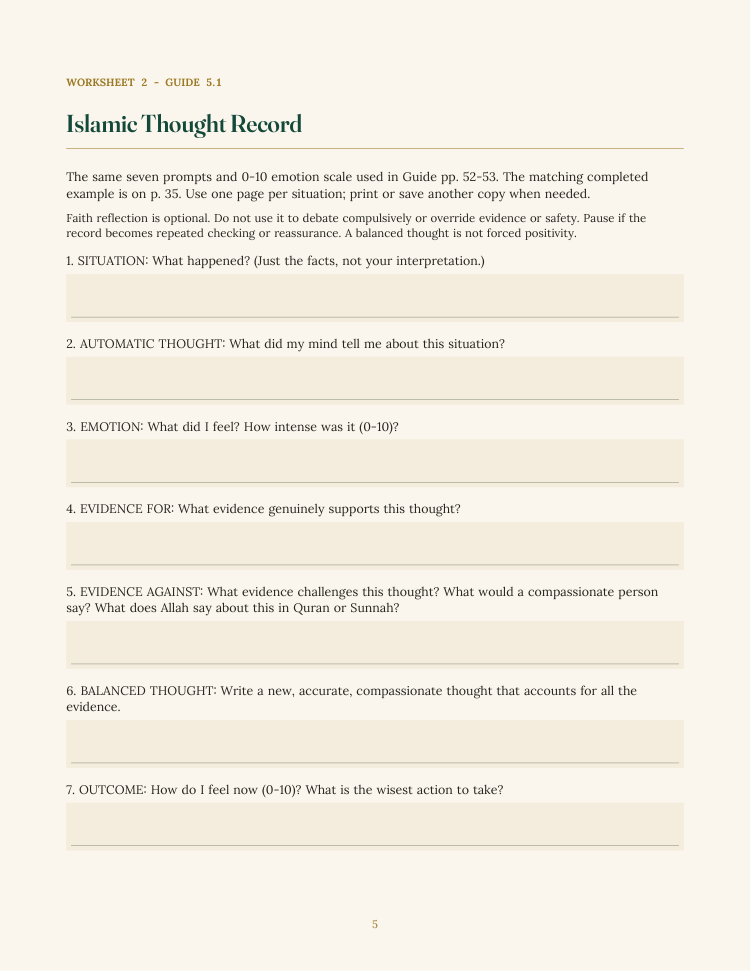
Workbook · page 5
One situation, examined fairly
Notice the thought, look at the evidence, and choose a balanced response. Faith reflection is optional.
8-week Islamic CBT self-help programme
Healing the Heart & Mind helps Muslim adults practise useful responses to everyday worry, harsh self-talk and low motivation through CBT self-help tools and faith-consistent reflection.
English-language PDFs · Self-paced · One payment · 30-day refund policy
Current guide + workbook in two formats + devotional companion
Important: MuslimCBT provides educational self-help resources, not therapy, diagnosis or medical treatment. The author is not a licensed psychologist, psychiatrist or therapist. If symptoms are severe, functioning is significantly impaired, or you are thinking about self-harm, seek qualified professional or emergency support. Read the full disclaimer.
A trustworthy self-help product should tell you where it fits — and where it does not.
This distinction is not a legal footnote. It is part of how MuslimCBT is designed to be used responsibly.
These previews come directly from the current workbook. Both pages are included in the free starter kit.
Workbook · page 5
Notice the thought, look at the evidence, and choose a balanced response. Faith reflection is optional.
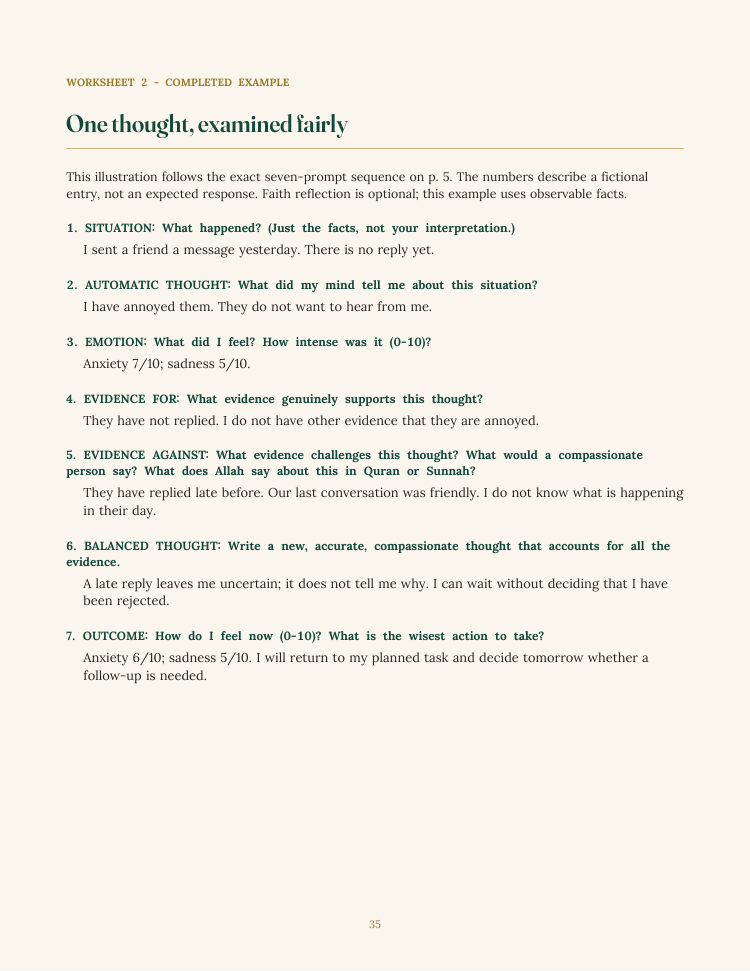
Workbook · page 35
An unanswered message becomes an opportunity to separate what happened from what the mind assumed. This is an illustration, not a customer outcome.
The goal is not to promise a particular emotional outcome. It is to give you a structured set of skills to practise repeatedly.
Identify automatic thoughts and common thinking traps before they quietly drive emotion and behaviour.
Use evidence, alternative explanations and balanced responses instead of accepting every anxious thought as fact.
Build a practical hierarchy and approach manageable situations step by step.
Plan small, realistic actions when low mood and withdrawal make momentum difficult.
Separate problems you can act on from repetitive worry that needs a different response.
Create a maintenance and relapse plan so useful tools remain available after the eight-week structure ends.
Learn the CBT model, emotional vocabulary and how Islamic concepts are being used.
Work through thought records, activity planning, worry tools, graded exposure and reflection exercises.
Use the eight-week structure to practise consistently in real-life situations.
Build a personal plan for continuing the skills and recognising early warning signs.
MuslimCBT does not claim that Islamic spiritual practices are clinically identical to CBT techniques. Established CBT exercises are taught in a faith-consistent context, with Quranic, Prophetic and classical Islamic reflections used where they help the reader understand or apply the exercise.
This distinction matters. It keeps the psychological tool recognisable while avoiding the claim that a religious practice needs a clinical label in order to have value.
Cognitive restructuring
Examine evidence and alternative explanations, then use relevant Quranic or Islamic reflection as context — not as a substitute for evidence testing.
Behavioural activation
Use manageable, meaningful activity to interrupt withdrawal, including ordinary life activities and religious practices where appropriate.
Graded exposure
Approach avoided situations gradually while using du'a and tawakkul as faith-consistent support rather than calling tawakkul itself “exposure therapy.”
Attention & reflection
Use Islamic practices as spiritual resources alongside attention and grounding exercises, without claiming they are interchangeable with clinical mindfulness protocols.
The programme teaches familiar CBT self-help exercises, including thought records, activity planning and worry management. Islamic material provides faith-consistent reflection alongside those tools.
Read our methodology and source policy →The current main guide identifies Dr Mishal Salem, PhD, as the external reviewer of its Islamic content and faith-sensitive framing. This does not establish clinical validation. The new devotional companion has not received a separate external scholarly review.
The programme is educational self-help. It has not been clinically validated as a treatment.
MuslimCBT · founded 2026
Founder & Researcher, MuslimCBT
MuslimCBT was created to explore how practical CBT concepts can be taught to Muslim readers in language that takes their religious worldview seriously. The work draws on modern psychological tools and classical Islamic writing on the inner life.
Work through the eight-week programme at your own pace.
Healing the Heart & Mind
Four PDF downloads. The print and fillable workbooks contain the same 50 pages.
$27
USD · one-time payment · no subscription
30-day refund policy. Review the terms and process before purchasing.
Four PDFs: the 137-page main guide, the 50-page workbook in print and fillable formats, and the 18-page Turning to Allah in Difficult Times companion. The two workbook formats contain the same material.
English-reading Muslim adults who want a structured way to practise self-help skills for everyday worry, harsh self-talk and low motivation. It can sit alongside appropriate professional support.
No. It is educational self-help and does not provide diagnosis or treatment. Significant impairment, severe distress or clinical OCD needs appropriate professional support.
The current main guide identifies Dr Mishal Salem, PhD, as the external reviewer of its Islamic content and faith-sensitive framing. This does not establish clinical validation. The new devotional companion has not received a separate external scholarly review.
Use the fillable workbook in a PDF reader that supports forms. Download, save a copy and reopen it to check that your entries have been kept. The print version is available if you prefer handwriting.
A five-page sample with the opening page of Chapter 1, a completed thought record, the matching blank record and simple instructions. Choose print or fillable.
Requests can be made within 30 days of purchase. See the refund policy for the full process.
Download the free starter kit and try a complete example. No purchase is required.
Get the free starter kit →Choosing professional care is not a failure of self-help. If you need a therapist, start with our educational guide on finding Muslim-sensitive mental-health support and verify each provider's credentials independently.